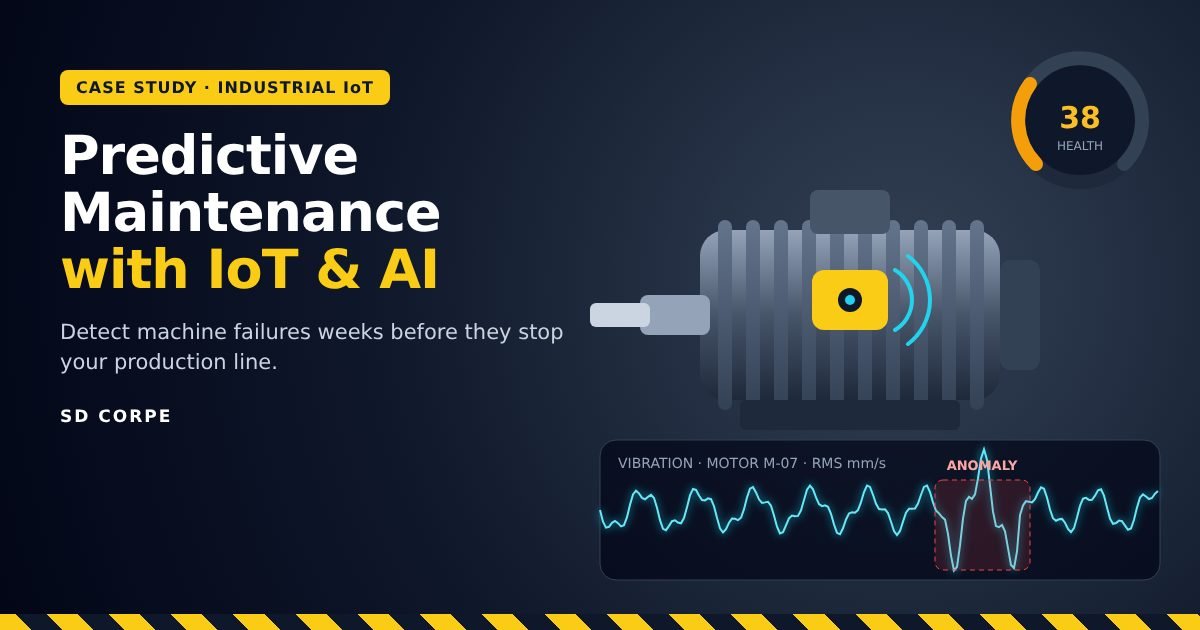
About this case study: this is an SD Corpe solution case study. It shows how we design and deliver IoT predictive maintenance systems for manufacturers and industrial operators. Benefit figures are industry benchmarks from published research (see References). Actual results depend on each plant, its assets and its data.
Executive summary
Unplanned downtime is one of the most expensive problems in industry. According to Siemens' True Cost of Downtime 2024 report, the world's 500 largest companies lose an estimated $1.4 trillion a year to unplanned downtime, around 11% of their revenues, and an idle line at a large automotive plant can cost up to $2.3 million per hour.
Most of those failures don't happen without warning. Bearings, gearboxes, pumps and motors give off early signs (changes in vibration, temperature and electrical current) weeks before they break down. The problem is that nobody is listening.
SD Corpe's IoT Predictive Maintenance solution puts smart sensors on critical machines, analyses their data at the edge and in the cloud, and alerts maintenance teams before a failure stops production. Published industry research links mature predictive maintenance programmes to 30–50% less machine downtime and 20–40% longer machine life.
The challenge
Manufacturers, utilities and process plants we work with typically face the same problems:
1. Costly unplanned downtime
A single failed motor or pump can stop an entire line. Beyond lost output, there are emergency repairs, overtime, rushed spare parts, missed deliveries and unhappy customers.
2. Calendar-based maintenance wastes money
Preventive maintenance services machines on a fixed schedule, regardless of their actual condition. Healthy parts are replaced too early, while unexpected failures between services still happen.
3. Manual inspections don't scale
Handheld vibration checks and walk-around inspections are periodic, labour-intensive and depend on skilled technicians, who are increasingly hard to find. Faults that develop between rounds are missed.
4. Hard-to-reach and critical assets
Machines in hazardous, hot, remote or enclosed locations are difficult and sometimes unsafe to inspect regularly.
5. Data silos
Machine data, if collected at all, often sits in separate PLCs, spreadsheets and systems, with no single view of asset health and no link to maintenance work orders.
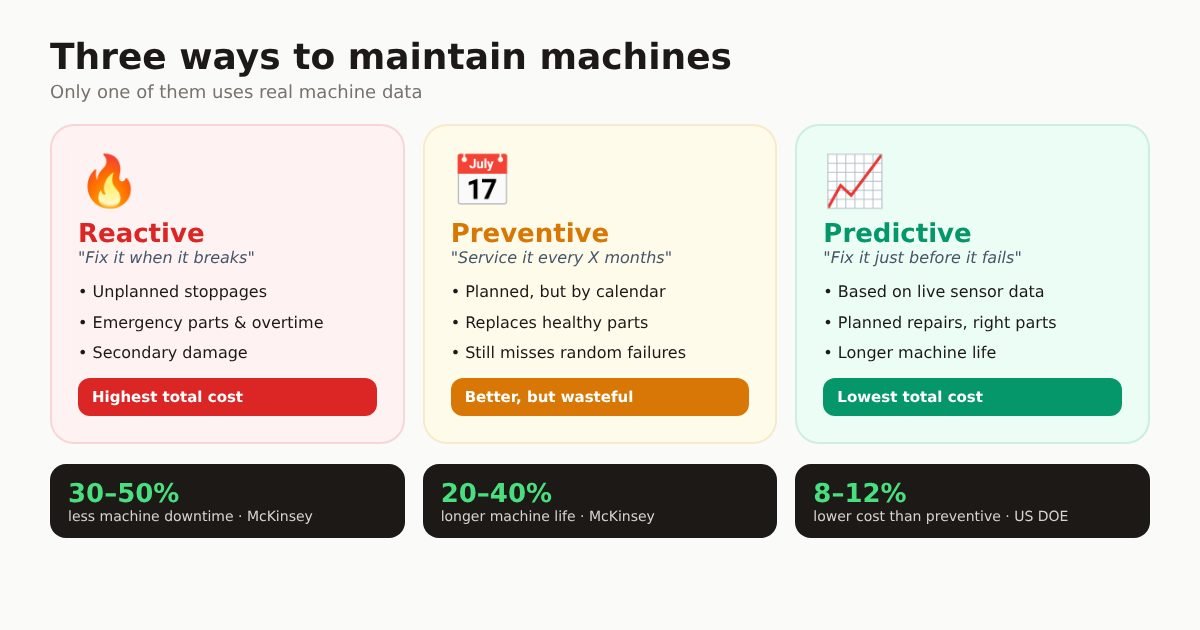
Reactive vs preventive vs predictive maintenance
- Reactive maintenance ("run to failure") fixes machines after they break. It is simple, but it's the most expensive approach due to downtime and secondary damage.
- Preventive maintenance services machines on a calendar or runtime schedule. It's better, but it replaces healthy parts and still misses random failures.
- Predictive maintenance monitors the actual condition of each machine and schedules work only when the data shows it's needed. The US Department of Energy's O&M guidance estimates predictive programmes save 8–12% compared with preventive and 30–40% compared with reactive maintenance.
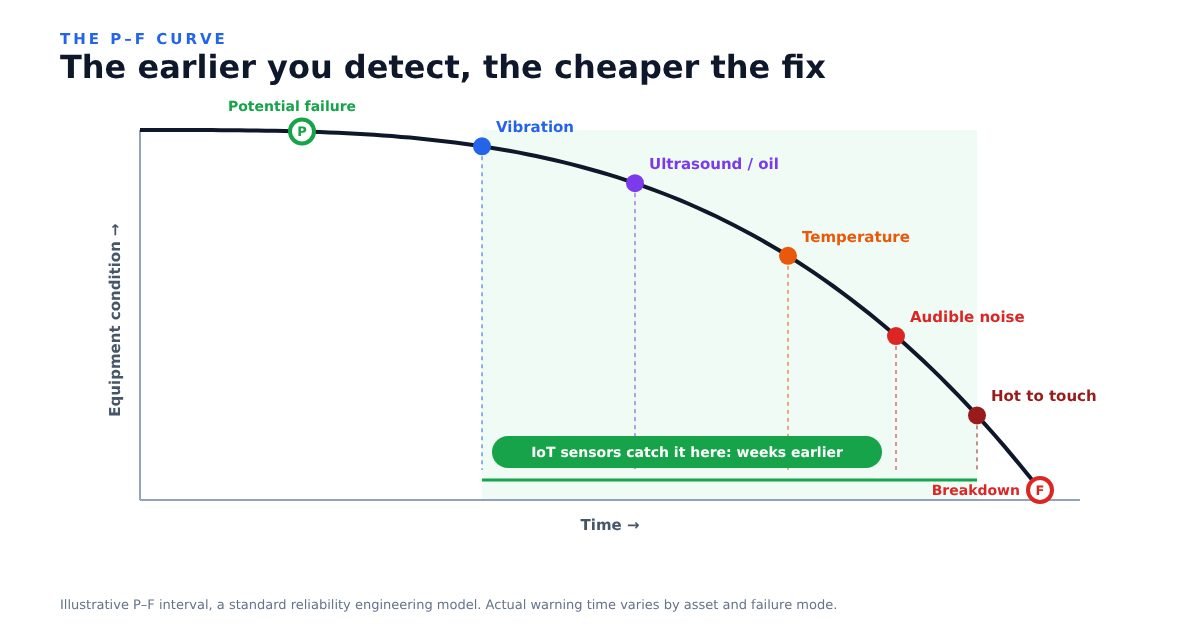
Why early detection matters: the P–F curve
Reliability engineers use the P–F curve to describe how equipment fails. Point P is when a developing fault first becomes detectable; point F is functional failure, or breakdown. The time between them is the window you have to plan a repair.
Changes in vibration usually appear first, followed by changes visible through ultrasound or oil analysis, then rising temperature, audible noise and finally heat you can feel. Continuous IoT vibration and temperature monitoring catches problems near the start of this curve, often weeks earlier than manual checks, giving teams time to order parts and schedule repairs during planned shutdowns.
Our solution
We designed an end-to-end predictive maintenance platform that can be retrofitted to existing machines without changing their controls, and scaled from a pilot on a few critical assets to entire plants.
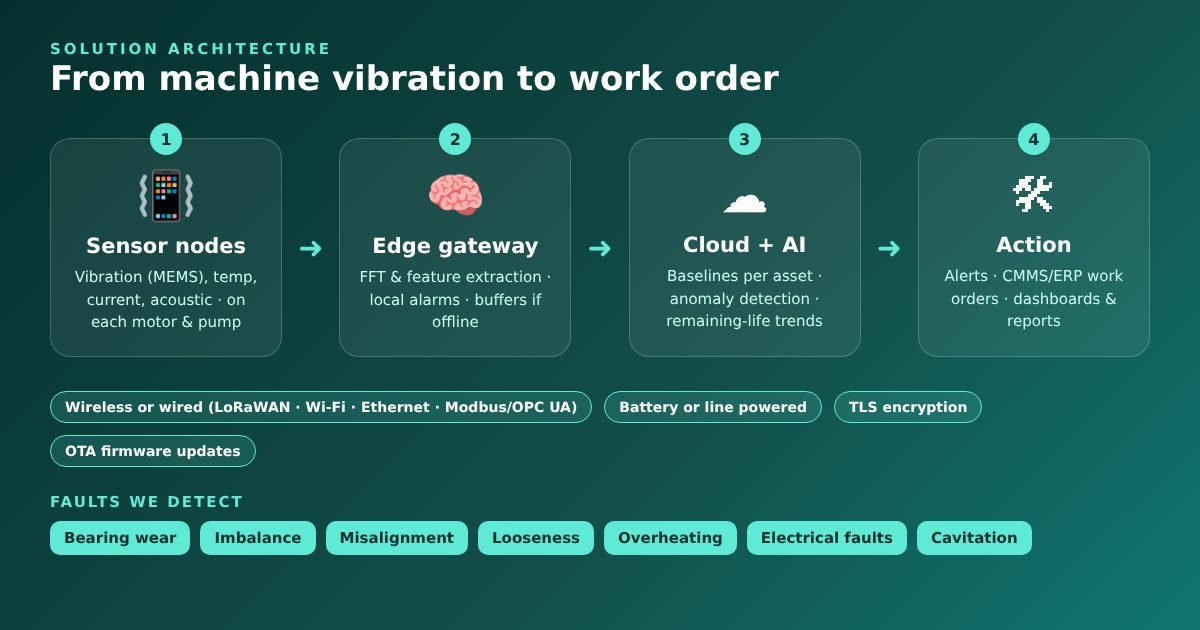
1. Smart sensor nodes
- Tri-axial MEMS vibration sensors capture acceleration and velocity data from motors, pumps, fans, compressors and gearboxes.
- Temperature, current and acoustic sensing add more signals for detecting overheating and electrical faults.
- Rugged industrial design: magnetic or stud mounting, sealed enclosures, and battery-powered wireless or line-powered wired options.
- Low-power firmware wakes, samples and transmits efficiently for long battery life.
2. Edge gateway and on-board analytics
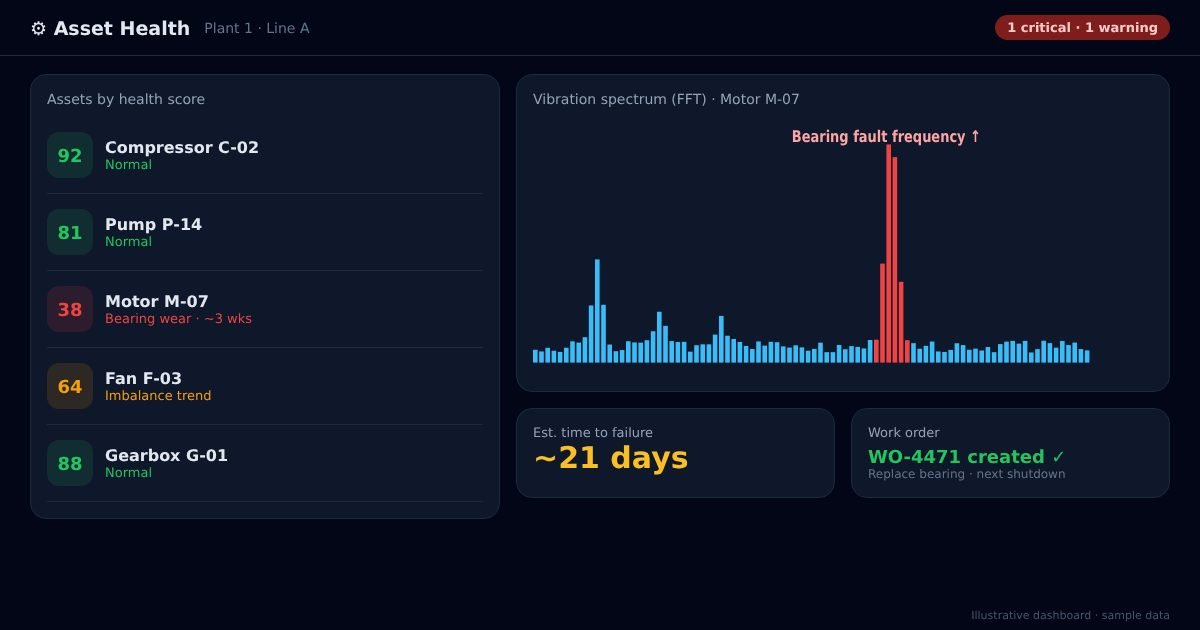
- Converts raw vibration into useful features: FFT spectrum, RMS velocity, peak, crest factor and kurtosis.
- Raises local alarms instantly, even without internet.
- Buffers data during network outages and forwards it securely when the connection returns.
- Connects to existing systems through Modbus, OPC UA and MQTT, and over Wi-Fi, Ethernet, LoRaWAN or cellular.
3. Cloud platform with AI analytics
- Learns a baseline of normal behaviour for each machine and operating condition.
- Anomaly detection flags unusual patterns that a fixed threshold would miss.
- Fault diagnostics recognise the signatures of common problems such as bearing wear, imbalance, misalignment and looseness.
- Trend analysis estimates how quickly health is declining, to help plan repairs.
- Alarm limits can follow recognised guidance such as ISO 20816 vibration severity standards.
4. Dashboards, alerts and work orders
- Asset health scores for every machine on one screen, ranked by risk.
- Alerts by email, SMS, app or Teams/Slack, with the likely fault and recommended action.
- CMMS/ERP integration automatically creates maintenance work orders (for example in SAP PM, Maximo or similar systems).
- Reports on uptime, failures avoided and maintenance performance.
How it works in practice
- Assess: together with the plant team, we identify critical assets, the ones whose failure costs most, and their typical failure modes.
- Install: sensors are mounted on motors, bearings and gearboxes in minutes, with no production stop required in most cases.
- Learn: the system builds a baseline of normal behaviour over the first weeks of operation.
- Monitor: data is analysed continuously at the edge and in the cloud.
- Alert: when a developing fault such as bearing wear is detected, the team gets an alert with the asset, fault type and severity.
- Act: a work order is created, parts are ordered and the repair is scheduled for the next planned shutdown.
- Improve: every confirmed fault and repair improves the models and the maintenance strategy.
Engineering challenges we solved
- High-frequency data, low power: vibration analysis needs fast sampling, but wireless sensors need long battery life. On-sensor processing sends features, not raw data, and captures full waveforms only when needed.
- Noisy industrial environments: electrical noise, metal structures and interference are handled through robust hardware design, shielding and reliable radio protocols.
- Different machines, different "normal": per-asset baselines and operating-state detection avoid false alarms when machines change speed or load.
- Brownfield integration: older machines and PLCs are connected without changing their control logic.
- OT cybersecurity: encrypted communication, device certificates, network segmentation and signed OTA firmware updates protect production networks.
- Scale: the platform supports from a handful of sensors to thousands of assets across multiple sites.
Results and benefits
Industry research and published programmes show what a well-implemented predictive maintenance system can deliver:
- 30–50% less machine downtime (McKinsey)
- 20–40% longer machine life (McKinsey)
- 8–12% lower maintenance costs than preventive, and 30–40% lower than reactive maintenance (US Department of Energy)
- 5–10% lower maintenance costs and 10–20% higher equipment uptime (Deloitte)
- Safer workplaces: fewer catastrophic failures and less manual inspection of hazardous equipment
- Smarter spare-parts planning: order the right parts at the right time, with less inventory
- Data-driven decisions: clear evidence for repair-or-replace and capital planning
Industries and assets
The solution is designed for any operation with rotating equipment, including:
- Manufacturing: motors, conveyors, CNC spindles, compressors
- Water and wastewater: pumps, blowers, mixers
- Oil, gas and chemicals: pumps, compressors, fans
- Food and beverage: process lines, refrigeration compressors
- Buildings and data centres: chillers, HVAC fans, cooling pumps
- Mining and cement: crushers, mills, gearboxes
Why SD Corpe
- End-to-end engineering: sensor hardware, embedded firmware, edge software, cloud analytics and dashboards from one team.
- Industrial connectivity expertise: Modbus, OPC UA, MQTT, LoRaWAN, cellular and Wi-Fi.
- AI-ready data platform: built to grow from rule-based alerts to machine-learning models.
- Security by design for OT environments.
- Pilot-first approach: prove value on a few critical assets, then scale.
- Global delivery with transparent pricing.
Frequently asked questions
Can predictive maintenance be added to old machines?
Yes. External vibration and temperature sensors can be mounted on almost any motor, pump or gearbox, regardless of age or brand, without changing the machine's controls.
How early can failures be detected?
It depends on the asset and failure mode, but faults like bearing wear often show up in vibration data weeks before breakdown, giving time to plan repairs.
Do we need data scientists to use the system?
No. The dashboard shows simple health scores, alerts and recommended actions. Experts can still dig into detailed vibration spectra when needed.
Wireless or wired sensors?
Wireless battery-powered sensors are quick to install and ideal for retrofits. Wired sensors suit critical, high-speed assets that need continuous high-resolution data. Many plants use both.
How do we start?
We recommend a pilot on 5–20 critical assets for a few months to prove value, then scaling across the plant.
References
- Siemens, The True Cost of Downtime 2024: siemens.com (PDF)
- McKinsey & Company, "Manufacturing analytics unleashes productivity and profitability": mckinsey.com
- Deloitte, "Predictive maintenance and the smart factory": deloitte.com
- US Department of Energy, Federal Energy Management Program, O&M Best Practices: energy.gov
- Reliability (ReliaMag), "Predictive Maintenance ROI Benchmarks: What the Studies Show": reliamag.com
Stop failures before they stop you
Want to reduce unplanned downtime in your plant? Book a free consultation with SD Corpe's industrial IoT team. We'll help you identify your most critical assets and design a predictive maintenance pilot with clear, measurable goals.