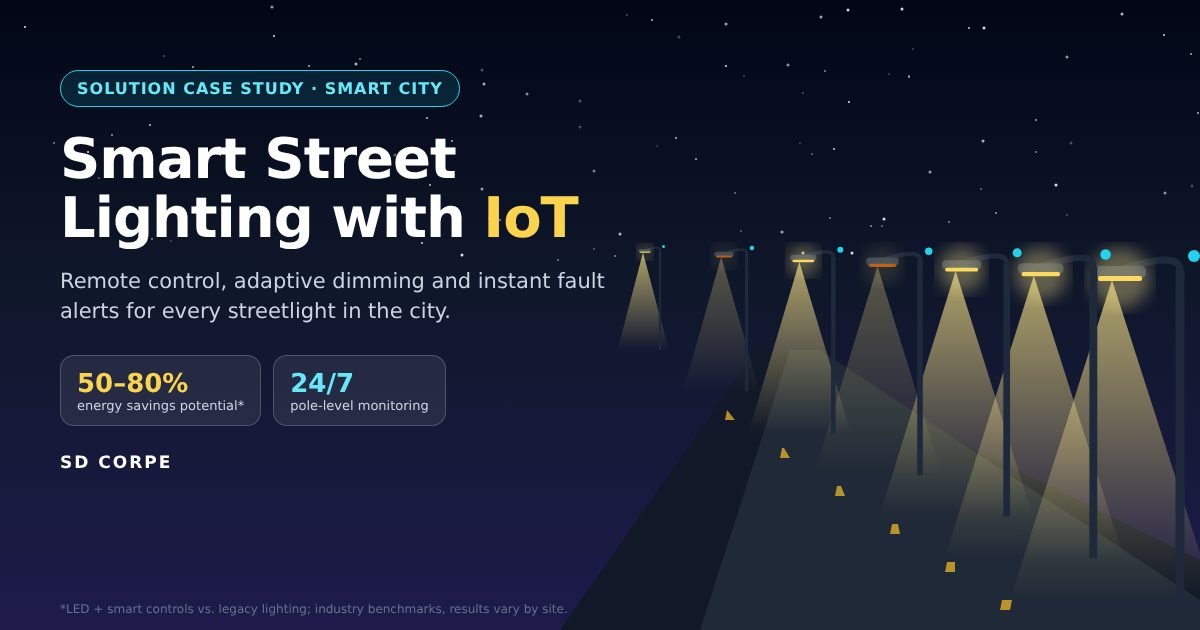
About this case study: this is an SD Corpe solution case study. It describes how we design and deliver IoT smart street lighting for municipalities, smart-city operators and infrastructure developers. Savings figures are industry benchmarks from published sources (see References). Actual results depend on each site.
Executive summary
Streetlights are one of the most visible public services a city provides, and one of its biggest energy costs. Industry sources estimate that street lighting can make up a large share of a municipality's electricity bill, in some cities well over a third. Yet most streetlights are still "dumb": they switch on at dusk, burn at full power all night and fail silently until a citizen complains.
SD Corpe's IoT Smart Street Lighting solution turns every streetlight into a connected, controllable and measurable device. A smart controller on each pole connects over a wide-area IoT network to a secure cloud platform, where city teams can monitor, schedule, dim and maintain every light from a single dashboard. Combined with LED luminaires, connected lighting with adaptive dimming has been reported to cut lighting energy use by 50–80% compared with legacy systems, while making streets safer and maintenance far more efficient.
The challenge
Cities and infrastructure operators we speak with face the same set of problems with conventional street lighting:
1. High and rising energy costs
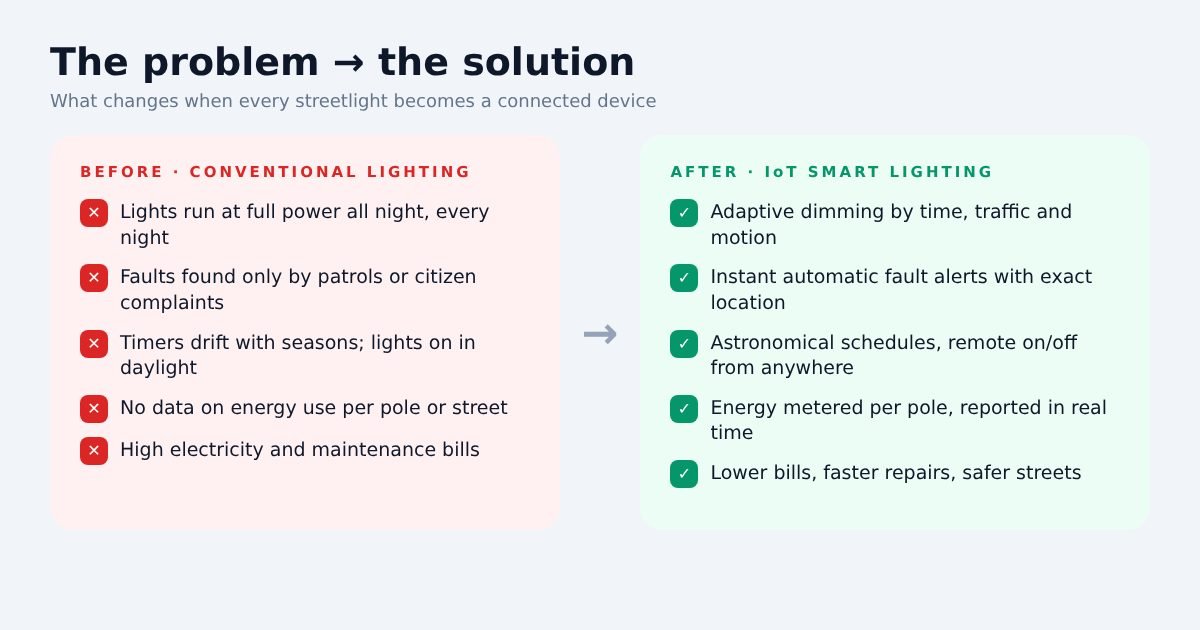
Conventional lights run at 100% output from dusk to dawn, even at 3 a.m. on an empty road. With electricity prices rising, lighting becomes a growing burden on municipal budgets.
2. Faults go unnoticed
Without monitoring, a failed lamp is only discovered during a night patrol or after a citizen complaint. Dark streets can stay dark for days or weeks, creating safety risks and reputational damage.
3. Inefficient, reactive maintenance
Crews drive around at night looking for faults, often without knowing what's wrong until they arrive. That means wasted fuel, overtime and repeat visits.
4. Inaccurate schedules
Simple timers and photocells drift with the seasons or fail, leaving lights on in daylight or off when it's dark.
5. No data for decisions
Cities can't see how much energy each street uses, which assets are ageing, or where to invest. Billing is often based on estimates rather than metered consumption.
6. Sustainability and smart-city targets
Many governments have committed to carbon-reduction goals. Lighting is one of the fastest, most measurable places to deliver savings, and a natural backbone for wider smart-city services.
Our solution
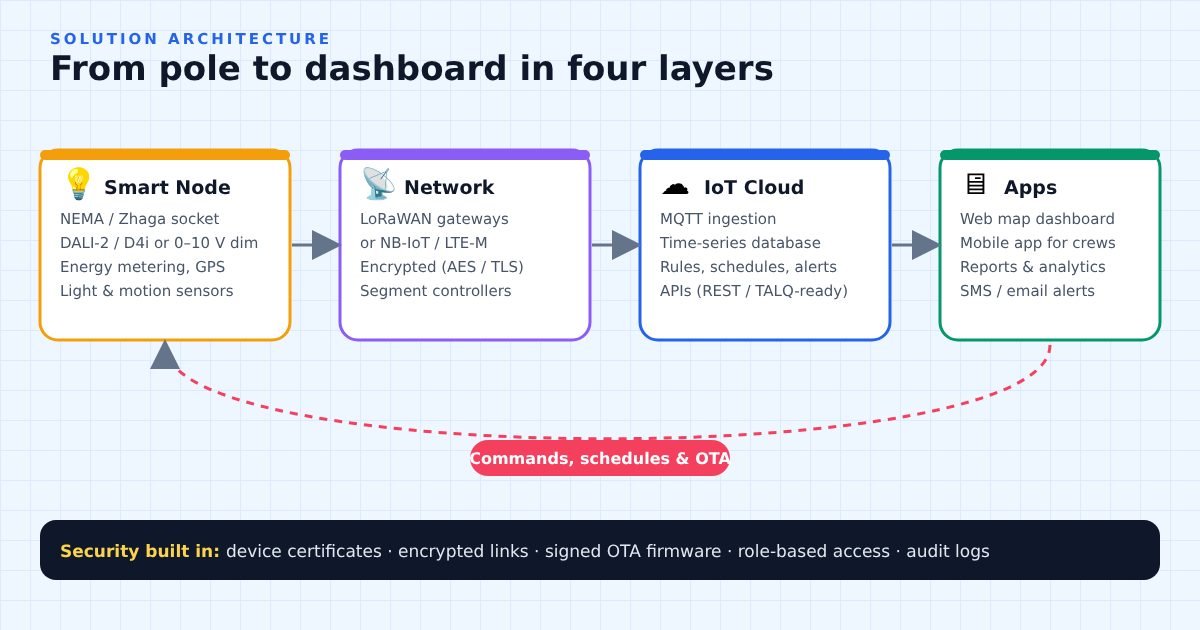
We designed an end-to-end IoT platform that covers everything from the controller on the pole to the dashboard in the control room. It is built to retrofit existing streetlight networks as well as new LED installations.
1. Smart lighting controller on every pole
- Plug-and-play mounting using industry-standard NEMA (ANSI C136.41) or Zhaga Book 18 sockets, so controllers can be installed or replaced in minutes without opening the luminaire.
- Dimming control through DALI-2/D4i or 0–10 V interfaces, compatible with leading LED drivers.
- Built-in energy metering for voltage, current, power and consumption per light.
- Fault detection for lamp failure, driver faults, power loss, over-current and tilt or damage.
- On-board intelligence: stored schedules and an astronomical clock keep lights working even if the network goes down.
- Optional sensors for ambient light and motion, plus GPS for automatic asset mapping.
2. Reliable wide-area connectivity
Depending on the city's needs and existing infrastructure, the solution supports:
- LoRaWAN: long range and low cost, with a private network of gateways mounted on poles or buildings. Ideal where the city wants full ownership with no per-device fees.
- NB-IoT / LTE-M: operator-managed cellular networks with no gateways to install. Ideal for scattered assets or quick deployment.
- All communication is encrypted end to end, with unique credentials for every device.
Learn more about choosing the right network in our guide: LoRaWAN vs NB-IoT vs LTE-M vs Wi-Fi.
3. Secure IoT cloud platform
- Scalable data ingestion over MQTT, with time-series storage for years of history.
- Rules engine for schedules, dimming profiles and alarms, applied to a single light, a street, a zone or the whole city.
- Open APIs (REST, with support for the TALQ smart-city interoperability approach) to integrate with asset management, ticketing, GIS and city command centres.
- Over-the-air firmware updates to add features and patch security without site visits.
4. Web dashboard and mobile app
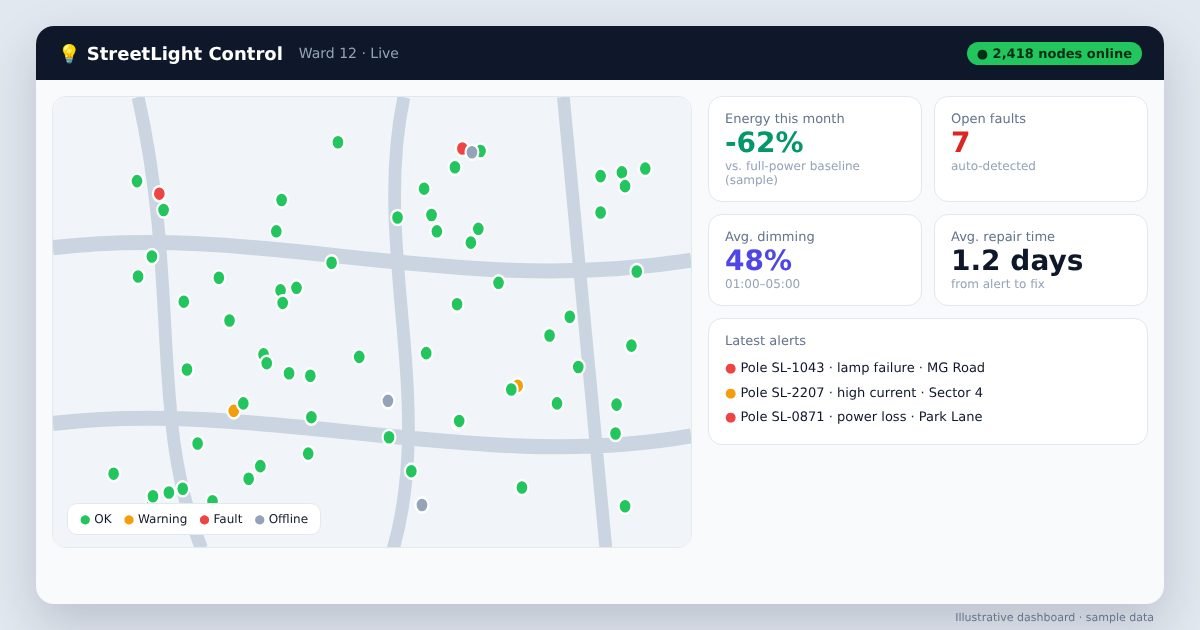
- Live map of every streetlight, colour-coded by status: OK, warning, fault or offline.
- Remote control: switch or dim any group of lights instantly, for example for events or emergencies.
- Automatic alerts by SMS, email or app notification, with exact pole location and fault type.
- Maintenance app for field crews: work orders, navigation to the pole, and fix confirmation.
- Reports: energy use and savings, carbon reduction, uptime and repair times.
How it works: a night on a smart street
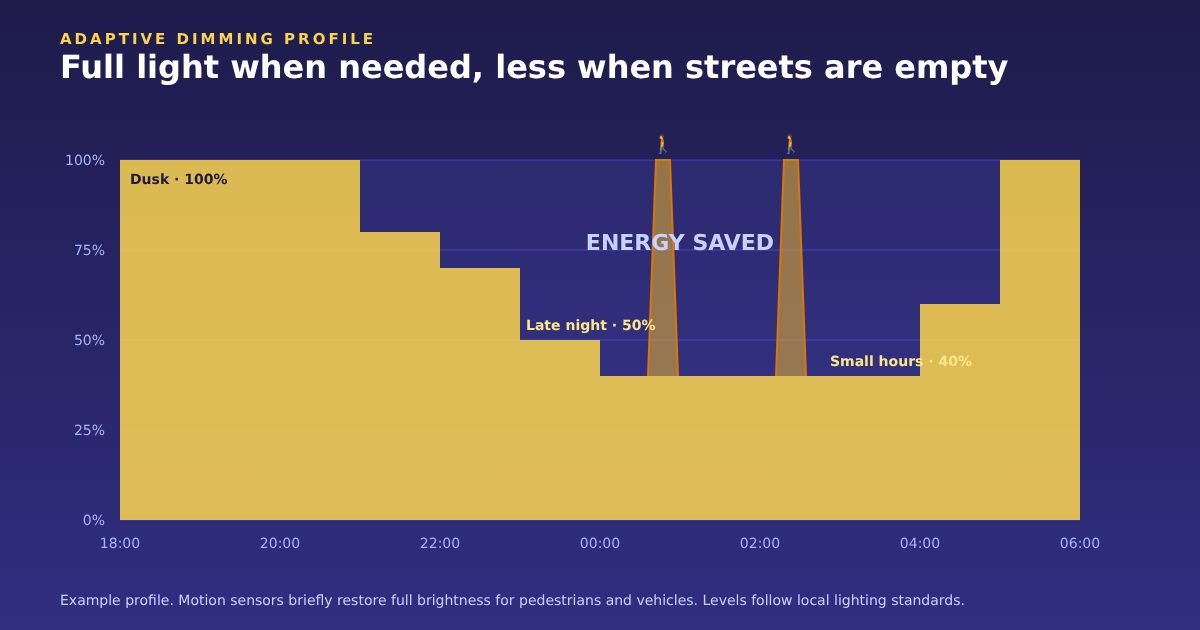
- Dusk: using an astronomical clock (and optional light sensors), lights turn on exactly when needed, with no drifting timers.
- Evening peak: lights run at full brightness while traffic and pedestrians are busiest.
- Late night: the dimming profile gradually lowers output on quieter roads, within the levels required by local lighting standards.
- Motion detected: where sensors are fitted, lights brighten for passing pedestrians or vehicles, then dim again.
- Fault occurs: the controller detects a lamp failure and the platform instantly raises an alert with location and fault type.
- Morning: a work order is ready for the crew, who arrive with the right parts. The fix is confirmed in the app.
- Every day: energy data from every pole feeds reports on savings, carbon reduction and asset health.
Engineering challenges we solved
- Harsh outdoor environments: controllers are designed for wide temperature ranges, moisture, dust (IP-rated enclosures) and electrical surges common on lighting circuits.
- Interoperability: support for standard sockets (NEMA, Zhaga) and dimming interfaces (DALI-2/D4i, 0–10 V) avoids lock-in to a single luminaire brand.
- Scale: the platform is built to manage from a few hundred to tens of thousands of lights, with group commands that reach thousands of nodes efficiently.
- Resilience: local schedules on each node keep streets lit safely even if connectivity or the cloud is unavailable.
- Cybersecurity: secure boot, encrypted links, signed OTA updates, role-based access and audit logs protect critical public infrastructure.
- Accurate metering: per-pole energy measurement supports savings verification and metered billing where utilities allow it.
Results and benefits
Every city is different, but published projects and industry studies point to the following benefits from connected street lighting:
- Energy savings: switching to LED plus smart controls and adaptive dimming has been reported to cut lighting energy by 50–80% compared with legacy systems.
- Lower maintenance costs: automatic fault detection removes night patrols and enables planned, first-time-fix repairs. Vendors report maintenance savings of up to around 50%.
- Faster repairs and safer streets: faults are known within minutes instead of days or weeks.
- Carbon reduction: lower energy use directly reduces emissions, with measured data for sustainability reporting.
- Better planning: real data on usage, failures and asset life supports smarter budgets and upgrades.
- Payback: industry estimates typically put the return on investment at 3–5 years, depending on local energy and labour costs.
Beyond lighting: the smart-street platform
Once every pole has power, connectivity and a controller, it becomes a platform for more smart-city services. The same system can be extended with:
- Air quality and noise monitoring
- Waterlogging and flood-level sensors at underpasses
- Smart parking sensors
- Traffic counting and analytics
- Public Wi-Fi, CCTV integration and emergency call points
- EV charging and smart-bin monitoring
Why SD Corpe
- End-to-end engineering: hardware design, embedded firmware, connectivity, cloud and apps from one team.
- Standards-based and vendor-neutral: designs built on open sockets, interfaces and APIs.
- Security by design: from secure boot to safe OTA updates.
- Built to scale: from a pilot street to a city-wide rollout.
- Global delivery: serving clients worldwide with transparent pricing and support.
Frequently asked questions
Can smart controllers be added to existing streetlights?
Yes. Many existing LED luminaires have NEMA or Zhaga sockets, and controllers can be retrofitted. Older lights can be upgraded to LED fixtures with smart-ready sockets at the same time.
What happens if the network goes down?
Each controller stores its schedule and dimming profile locally, so lights keep working normally. Data is synchronised when the connection returns.
Which network is best for smart street lighting?
LoRaWAN is popular for city-owned private networks with no per-device fees, while NB-IoT and LTE-M avoid installing gateways. We help choose based on coverage, scale and budget.
How long does a deployment take?
A pilot on a few streets can typically be live within weeks. City-wide rollouts are phased by zone, depending on the number of poles and installation crews.
References
- Tvilight, "Smart Street Lighting: Business Case for Municipalities" (cites World Bank and academic sources on lighting energy share, dimming and savings): tvilight.com
- European Commission CORDIS, "New system of intelligent management of street lighting enables 80% savings in energy": cordis.europa.eu
- Schréder, "Interfaces between external control devices and lighting assets: NEMA or Zhaga-D4i?": schreder.com
- Tvilight, "Zhaga-D4i: a de facto standard for smart street lights": tvilight.com
- LoRa Alliance, "Smart Street Lighting system" (LoRaWAN use case): lora-alliance.org
Light up your city with SD Corpe
Planning a smart street lighting pilot, upgrading to LED, or building a smart-city platform? Book a free consultation with our IoT team, and we'll help you design a solution that cuts costs, improves safety and scales with your city.