What firmware development covers
Firmware is the software that runs directly on a device's microcontroller. It reads the sensors, drives the motors and displays, talks to other devices and decides what happens when something fails. Good firmware is invisible: the product simply works, starts quickly, uses little power and recovers on its own from the problems real installations throw at it.
SD Corpe writes firmware for new products and takes over existing codebases that have become hard to change. We work in C and C++, with Python for test tools and automation, and we use the same engineering practices on a small sensor as on a complex controller.
What we deliver
- Bare-metal firmware. Lean firmware without an operating system for simple or cost-sensitive devices, where every byte of memory and every microamp counts.
- RTOS-based applications. FreeRTOS applications with clearly separated tasks, priorities and message queues, for products that handle communication, user input and control at the same time.
- Device drivers. Drivers for sensors, displays, memory, radios and power chips, written against the datasheet and tested on real hardware.
- Communication protocols. UART, SPI and I2C between chips, CAN bus and Modbus for industrial equipment, and the higher-level protocols your product uses to talk to gateways, apps or the cloud.
- Optimization and debugging. Finding crashes, memory leaks, timing problems and excessive power use with JTAG/SWD debuggers, logic analyzers and careful logging.
- Legacy firmware modernization. Restructuring old firmware so it can be maintained, adding tests, moving it to a newer microcontroller or adding features that the original design never planned for.
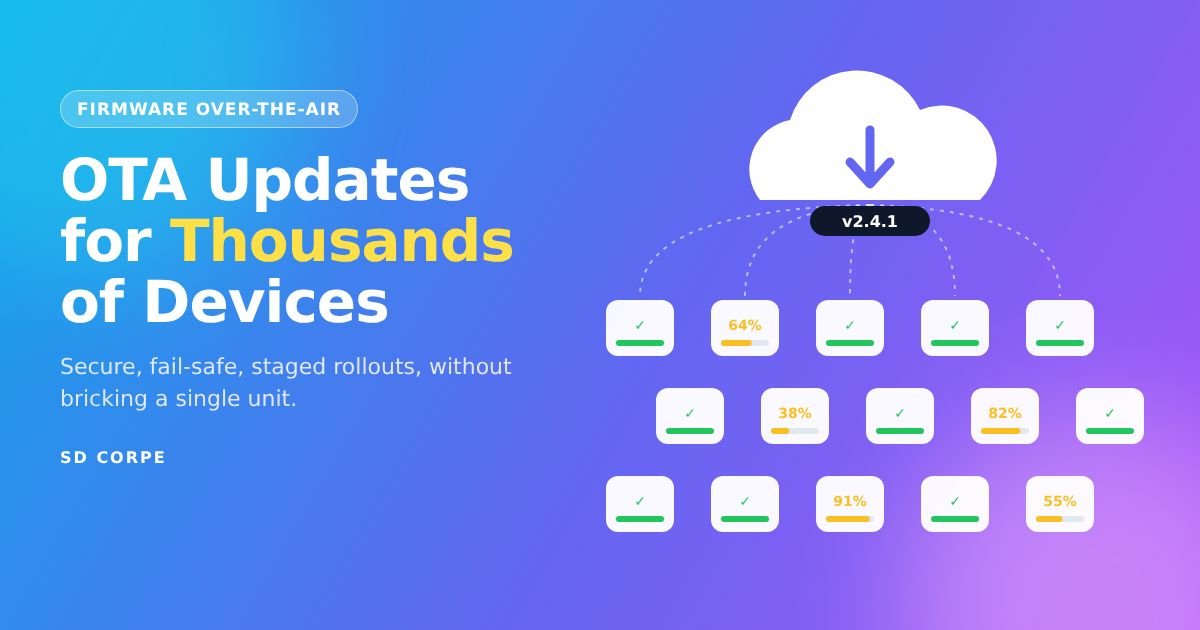
- OTA update support. Firmware that can be updated safely in the field, with image verification and rollback when an update fails.
Bare-metal or RTOS?
A bare-metal design runs one main loop and handles events with interrupts. It is simple, predictable and ideal for small devices with one clear job. An RTOS such as FreeRTOS lets the firmware run several tasks with their own priorities, which keeps a product responsive when it has to manage a radio, a display, sensors and control logic at once. We recommend one or the other based on the device, not on habit, and we explain the trade-off before work starts.
How we write firmware
- Clear structure. A modular architecture with a hardware abstraction layer, so drivers, business logic and communication can be changed independently.
- Version control and reviews. All code lives in Git, with tagged releases so any device in the field can be traced back to the exact code it runs.
- Testing at several levels. Unit tests for the logic, integration tests on the target hardware, and stress tests for power loss, bad input and lost connections.
- Documentation. Build instructions, architecture notes and protocol descriptions, so your own engineers or a future supplier can continue the work.
Taking over existing firmware
Many projects come to us with firmware that already exists but has become a problem: the original developer has left, devices reset at random, or a component has gone out of production. We start by reviewing the code and hardware and reproducing the reported problems, then give you a written assessment with options, from targeted fixes to a planned rewrite.
Why work with SD Corpe
Our firmware engineers sit next to the people who design the hardware and the cloud and app software. Problems that cross those boundaries, such as a radio that drops out when a motor starts, get solved quickly instead of being passed between suppliers. Since 2022 we have delivered 150+ projects for 50+ clients, and all intellectual property is transferred to you when the project is complete.