Your IoT device is only as good as its connection. Pick the wrong wireless technology and you can end up with batteries that die in weeks instead of years, sensors that lose signal in basements, or monthly data bills that wipe out your margins.
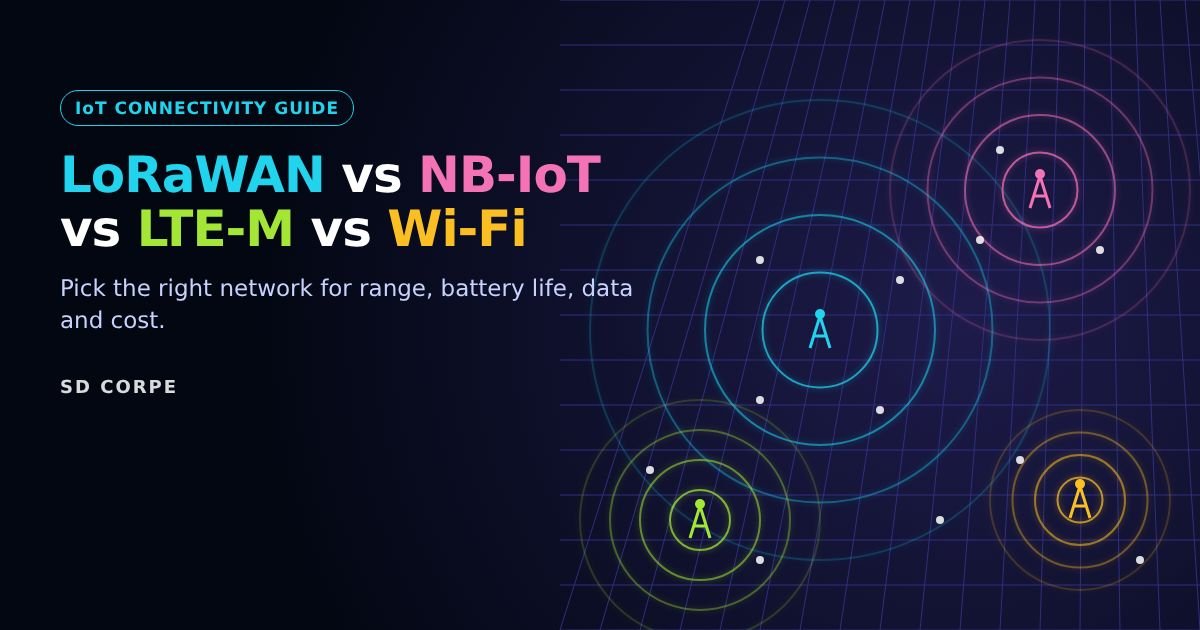
With so many options (LoRaWAN, NB-IoT, LTE-M, Wi-Fi, Bluetooth and more), choosing the right IoT connectivity can feel overwhelming. In this guide we compare the most popular technologies on range, battery life, data rate, coverage and cost, and give you a simple framework to choose the right one for your product.
Quick answer
- Wi-Fi: best for mains-powered indoor devices that need high bandwidth, such as cameras, appliances and smart-home hubs.
- LoRaWAN: best for battery-powered sensors sending small amounts of data over long distances, such as farms, utilities and smart cities.
- NB-IoT: best for static devices in hard-to-reach places, such as meters and parking sensors, where operator coverage exists.
- LTE-M: best for devices that move, need more data or need reliable over-the-air (OTA) updates, such as trackers, wearables and payment terminals.
- BLE, Thread or Zigbee: best for short-range devices that connect to a phone or a smart-home mesh.
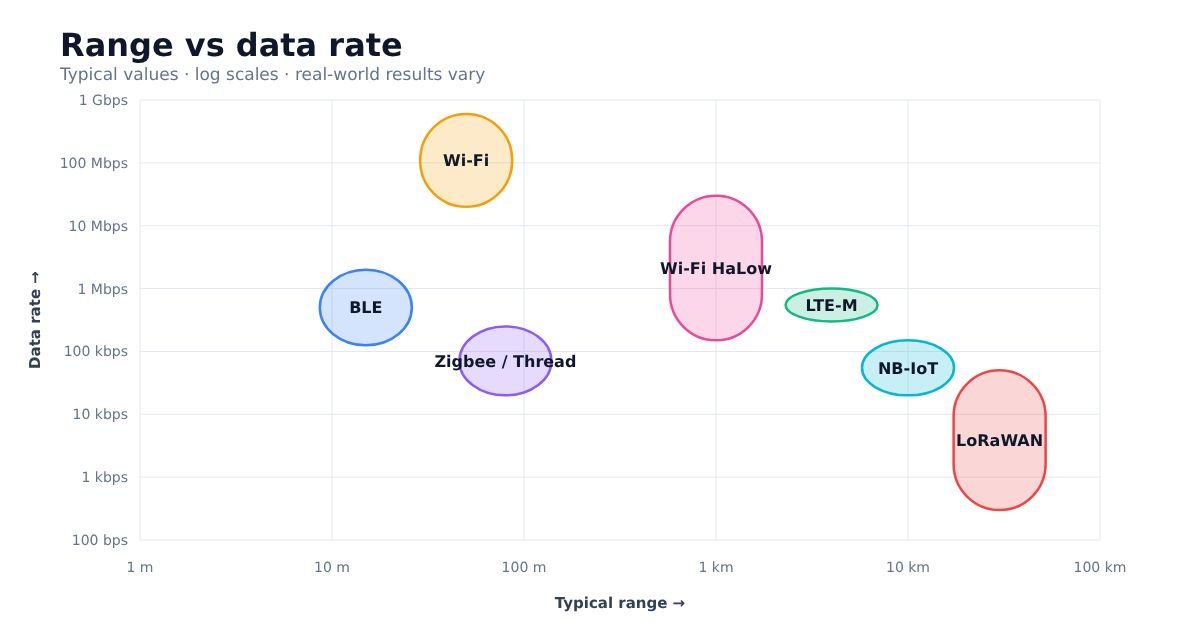
The key factors to compare
Before comparing technologies, be clear about what your product really needs:
- Range: metres, hundreds of metres, or kilometres?
- Power source: mains power, rechargeable battery, or a battery that must last for years?
- Data volume: a few bytes per hour, or continuous streams like audio and video?
- Mobility: is the device fixed in one place, or does it travel?
- Coverage: indoors, underground, rural, or across countries?
- Cost: module price, certification and ongoing network or subscription fees.
- Latency and control: does the device need to respond instantly to commands?
LoRaWAN: long range, ultra-low power
LoRaWAN is a low-power wide-area network (LPWAN) that uses unlicensed radio spectrum. A single gateway can cover several kilometres in cities and often much more in open rural areas. Devices can run for years on a battery.
- Pros: excellent range and battery life; you can deploy your own private network, so there are no per-device operator fees; strong ecosystem; works well for remote areas.
- Cons: very low data rates; not suited to large files, firmware updates over the air are slow; you may need to install and maintain gateways; duty-cycle limits in some regions.
- Best for: agriculture, water and environmental monitoring, utilities, smart buildings, campus and smart-city sensors.
NB-IoT: deep coverage on cellular networks
NB-IoT (Narrowband IoT) is a cellular LPWAN standard that runs on licensed mobile operator networks. It's designed for small amounts of data and very good building penetration, so it can reach meters in basements.
- Pros: excellent indoor and underground coverage; long battery life; no gateways to manage; operator-grade security.
- Cons: limited data rate and no real mobility support; availability varies by country and operator, and some operators have retired their NB-IoT networks; roaming can be limited.
- Best for: smart meters, parking sensors, static industrial sensors and smoke detectors.
LTE-M: cellular IoT that moves
LTE-M (LTE Cat-M1) is another cellular IoT standard, offering higher data rates than NB-IoT, lower latency, support for moving devices and, on some networks, voice. It's widely deployed and generally has better roaming support.
- Pros: supports mobility and handover between cells; enough bandwidth for OTA updates; good battery life with power-saving modes; broad international availability.
- Cons: uses more power than NB-IoT or LoRaWAN; requires a SIM and data plan; certification (including carrier approval) adds cost.
- Best for: asset and fleet trackers, wearables, connected health devices, payment terminals and alarm panels.
Wi-Fi: high bandwidth, existing infrastructure
Wi-Fi is everywhere in homes and offices, delivers high data rates and needs no extra network fees. Newer standards such as Wi-Fi 6 improve efficiency, and Wi-Fi HaLow (802.11ah) extends range to the kilometre scale at lower power for some IoT uses.
- Pros: high bandwidth; uses existing networks; low module cost (for example, ESP32); easy cloud connection.
- Cons: relatively high power consumption; limited range; depends on the customer's network and setup (onboarding can be tricky).
- Best for: smart-home devices, cameras, appliances, gateways and any mains-powered indoor product.
Don't forget short-range options
- Bluetooth Low Energy (BLE): perfect for devices that connect to a smartphone app, such as wearables, beacons and smart locks. Very low power and low cost.
- Thread and Zigbee: low-power mesh networks for smart homes and buildings. Thread is a key part of the Matter smart-home standard.
- Satellite IoT: an emerging option for truly remote locations such as oceans, deserts and mines, increasingly integrated with cellular standards.
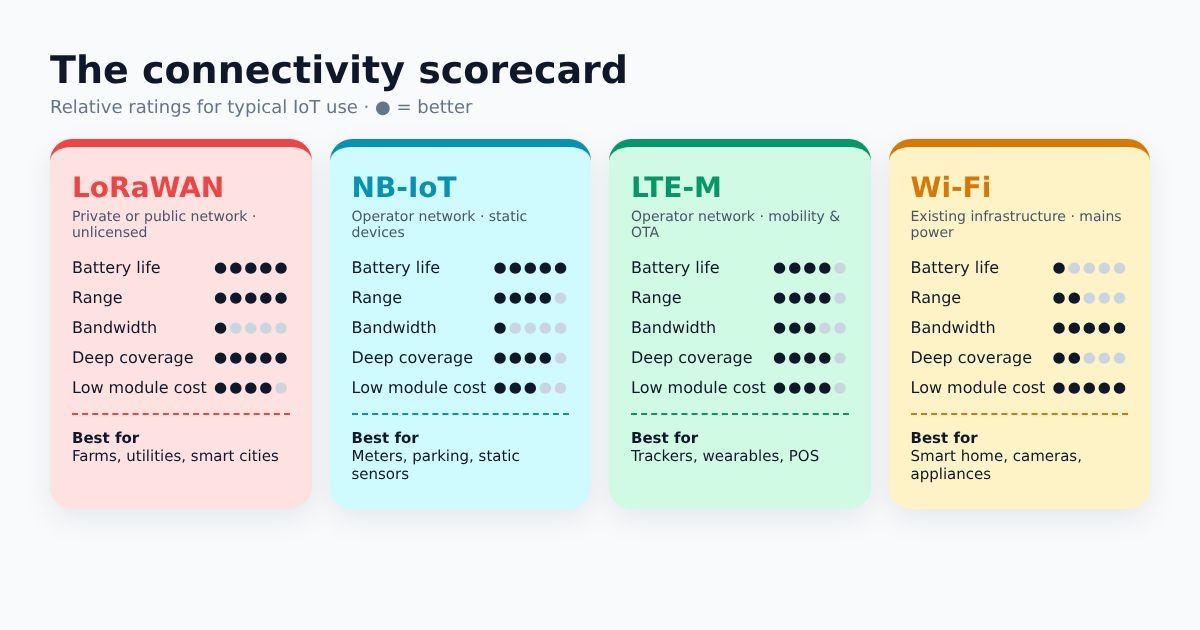
Side-by-side comparison
- Typical range: Wi-Fi tens of metres · LoRaWAN several km (more in rural areas) · NB-IoT and LTE-M wherever the operator has coverage
- Data rate: Wi-Fi highest · LTE-M up to around 1 Mbps · NB-IoT tens to low hundreds of kbps · LoRaWAN well below 50 kbps
- Battery life: LoRaWAN and NB-IoT best · LTE-M good · Wi-Fi lowest
- Mobility: LTE-M best · Wi-Fi limited · NB-IoT and LoRaWAN mainly for static devices
- Ongoing fees: Wi-Fi and private LoRaWAN have no subscription · NB-IoT and LTE-M require data plans
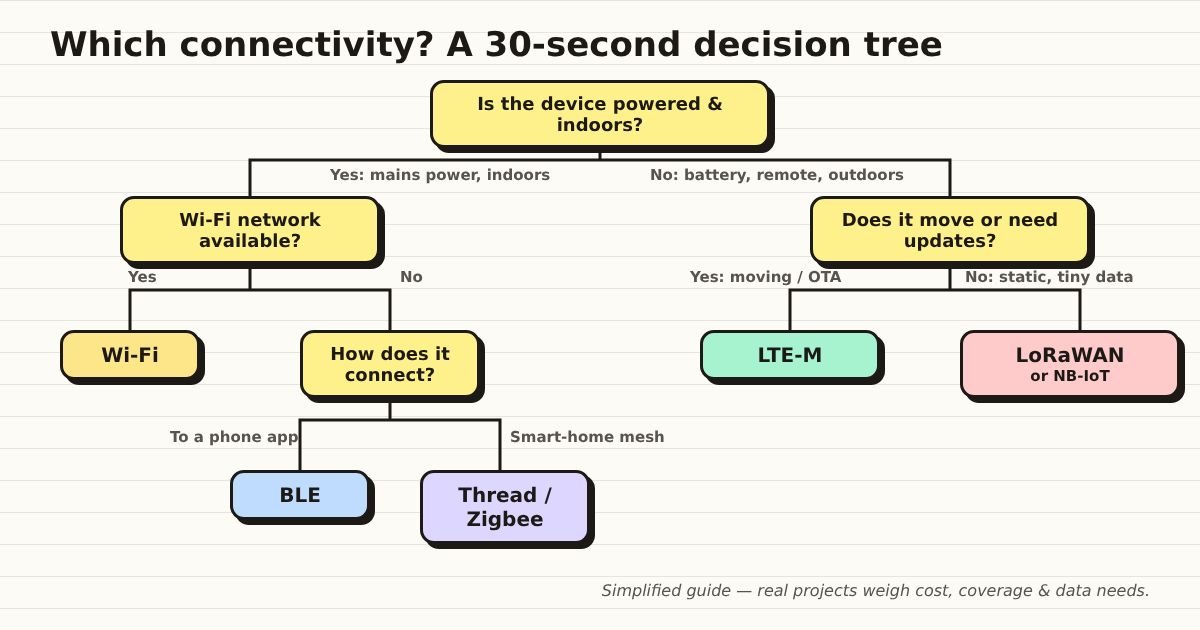
A practical decision framework
- Start with power. If the device is mains-powered and indoors with Wi-Fi available, Wi-Fi is usually simplest.
- Consider the user. If it pairs with a phone, choose BLE. For smart-home ecosystems, consider Thread/Matter or Zigbee.
- For remote, battery-powered devices: if they move or need regular OTA updates, choose LTE-M. If they're static and send tiny amounts of data, choose LoRaWAN or NB-IoT.
- Check coverage where you'll deploy. Confirm operator networks (and roaming) in every target country, or plan your own LoRaWAN gateways.
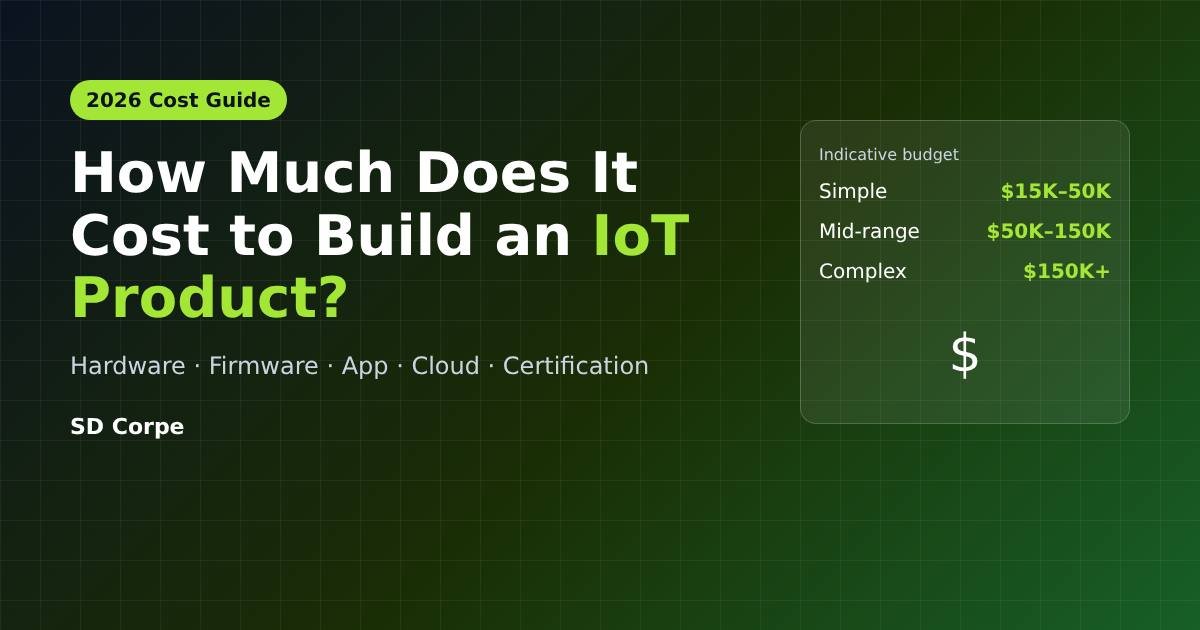
- Calculate total cost of ownership. Include modules, certification, gateways, data plans and battery replacements over the product's life.
Tip: many professional products combine technologies, for example BLE for setup through a phone app plus LTE-M or LoRaWAN for long-range data.
Common connectivity mistakes
- Choosing a technology before testing coverage at real deployment sites
- Underestimating power use during connection, retries and OTA updates
- Ignoring network sunsets (2G and 3G have been switched off in many countries)
- Forgetting certification and carrier approval in the budget
- Not designing a smooth onboarding experience for Wi-Fi devices
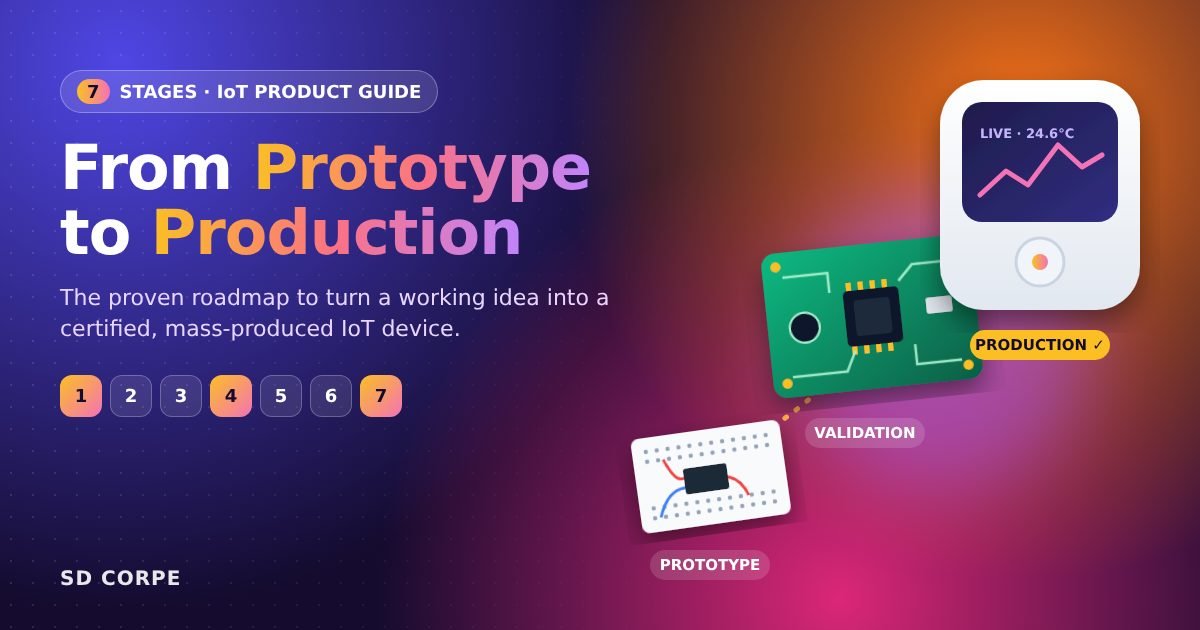
Planning your hardware too? Read ESP32 vs STM32 vs nRF52 and the 7 stages of IoT product development.
Frequently asked questions
What is the difference between LoRaWAN and NB-IoT?
LoRaWAN uses unlicensed spectrum and lets you run your own network with gateways, with no per-device fees. NB-IoT runs on licensed mobile operator networks, so there are no gateways to manage, but it requires a SIM and data plan and depends on operator availability.
Is LTE-M better than NB-IoT?
Neither is better overall. LTE-M offers higher data rates, lower latency and mobility, so it suits trackers and devices that need OTA updates. NB-IoT offers deeper coverage and slightly lower power for static devices sending small amounts of data.
Which IoT connectivity has the longest battery life?
LPWAN technologies such as LoRaWAN and NB-IoT generally deliver the longest battery life, often several years, as long as the device sends small amounts of data infrequently.
Can I use Wi-Fi for battery-powered IoT devices?
Yes, with careful power design (deep sleep and short connection windows), but battery life is usually much shorter than with BLE or LPWAN technologies.
Is 5G relevant for IoT?
Yes. LTE-M and NB-IoT are part of the 5G massive IoT roadmap, and newer 5G features such as RedCap target mid-range IoT devices that need more bandwidth than LTE-M.
Need help choosing the right connectivity?
At SD Corpe, we design IoT products with Wi-Fi, BLE, LoRaWAN, NB-IoT and LTE-M connectivity for clients worldwide, from antenna and hardware design to firmware, cloud and certification support.
Tell us about your product in a free consultation, and we'll recommend the connectivity that fits your range, battery and budget.