The microcontroller you choose on day one shapes your product for years. It decides your battery life, your wireless options, your bill of materials, your certification path, and even how easy it is to hire firmware developers. Get it wrong, and you could be facing a costly board redesign just before launch.
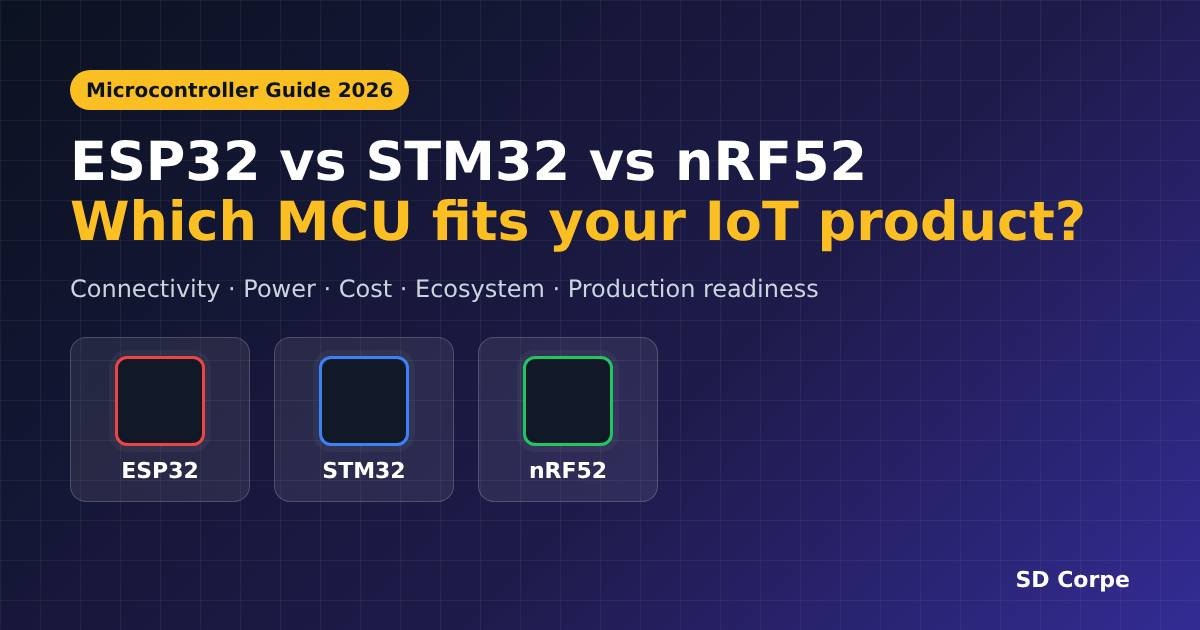
Three families come up again and again in IoT projects: Espressif's ESP32, ST's STM32 and Nordic's nRF52. All three are excellent, but they are built for different jobs. In this guide we compare them across the factors that matter for a real product, not just a hobby project, and help you decide which one fits yours.
Quick answer
- Choose ESP32 if your device needs Wi-Fi and a direct cloud connection at a low unit cost.
- Choose nRF52 (or the newer nRF54) if your device runs on a battery and talks to a smartphone over Bluetooth Low Energy.
- Choose STM32 if you need industrial reliability, real-time control, lots of peripherals, or the widest range of performance and power options.
ESP32: the Wi-Fi workhorse
The ESP32 family from Espressif made Wi-Fi IoT affordable for everyone. Most variants combine a capable processor with built-in Wi-Fi and Bluetooth LE on a single low-cost chip, and pre-certified modules make RF design and certification much simpler.
Popular variants
- ESP32-S3: dual-core with vector instructions, good for displays, cameras and on-device AI (voice, simple vision).
- ESP32-C3: low-cost single-core RISC-V with Wi-Fi and BLE, ideal for simple connected devices.
- ESP32-C6: adds Wi-Fi 6 plus an 802.15.4 radio for Thread and Zigbee, a strong option for Matter smart-home products.
Strengths
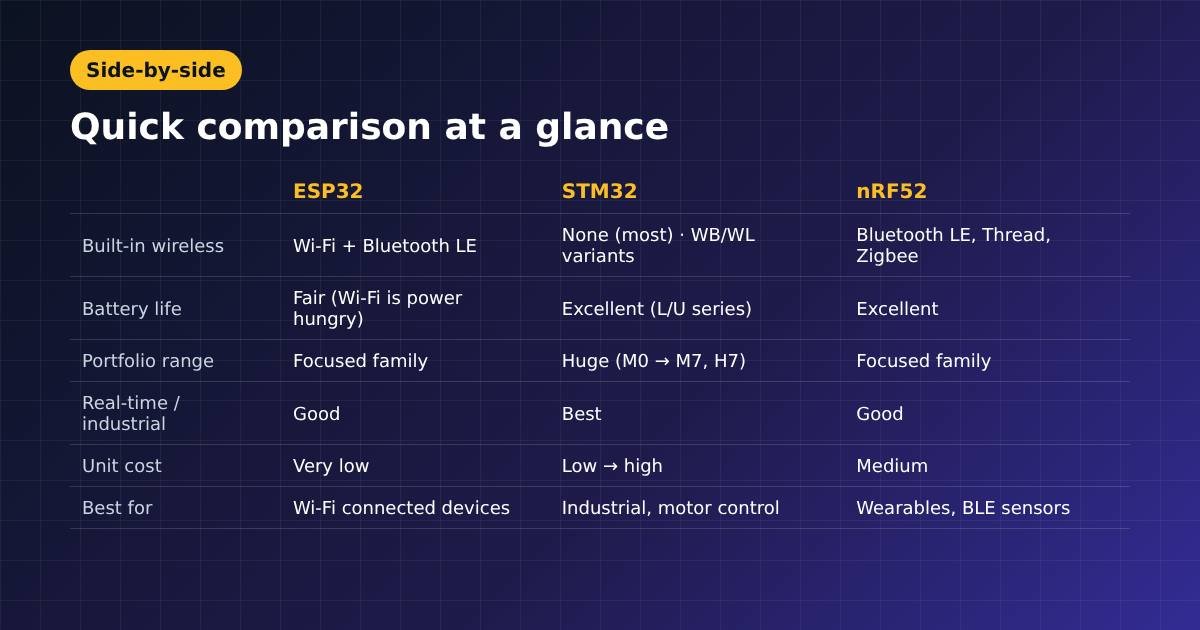
- Wi-Fi and BLE built in at a very low price
- Large community, mature ESP-IDF framework, Arduino support
- Fast prototyping and quick time to market
Watch out for
- Higher power draw when Wi-Fi is active, so it's not ideal for multi-year coin-cell devices
- Fewer advanced analog and motor-control peripherals than STM32
Best for: smart plugs and switches, home automation, Wi-Fi sensors, gateways, connected appliances and mains-powered devices.
STM32: the industrial all-rounder
STM32 is one of the largest Arm Cortex-M families on the market, ranging from tiny Cortex-M0+ parts to high-performance Cortex-M7 chips. Whatever your performance, power or package needs, there is very likely an STM32 that fits.
Popular series
- STM32F4 / G4: general-purpose and motor control, with strong analog peripherals.
- STM32H7: high-performance processing, graphics and complex HMI.
- STM32L / U series: ultra-low power for battery-operated devices.
- STM32WB / WL: wireless variants with Bluetooth LE (WB) or LoRa (WL) built in.
Strengths
- Huge portfolio with easy migration between parts
- Rich peripherals: advanced timers, ADCs, CAN, USB, Ethernet
- Proven in industrial, medical and automotive-grade designs
- Strong tools: STM32CubeIDE, CubeMX, and wide RTOS support
Watch out for
- Most parts have no built-in radio, so you'll need an external module for Wi-Fi or cellular
- A steeper learning curve than Arduino-style ESP32 development
Best for: industrial controllers, motor drives, medical devices, data loggers, PLC-style equipment and LoRaWAN sensors.
nRF52: the Bluetooth Low Energy specialist
Nordic Semiconductor's nRF52 series (such as the nRF52832 and nRF52840) is a go-to choice for battery-powered Bluetooth products. Nordic's newer nRF54 series builds on it with lower power and more processing headroom, so it's worth considering for new designs.
Strengths
- Excellent low-power radio performance for long battery life
- Bluetooth LE, plus Thread and Zigbee on supported parts (such as the nRF52840)
- Strong SDK (nRF Connect SDK, built on Zephyr RTOS) and very good documentation
- Widely used in wearables and medical devices
Watch out for
- No Wi-Fi, so it needs a phone or gateway to reach the cloud
- A higher unit cost than ESP32
Best for: wearables, fitness and health trackers, BLE beacons, asset tags, smart locks and coin-cell sensors.
Head-to-head: the factors that matter
Connectivity
Start here. If the device must talk to the internet over Wi-Fi without a gateway, ESP32 is usually the simplest answer. If it pairs with a phone app, nRF52 leads. If it uses wired buses, LoRa or cellular, STM32 with the right radio module gives the most flexibility.
Power consumption and battery life
For devices that must last months or years on a small battery, nRF52/nRF54 and STM32 L/U series are the strongest choices. ESP32 can sleep efficiently, but Wi-Fi connections use a lot of energy, so it suits mains-powered or rechargeable products best.
Cost
ESP32 usually offers the lowest cost for a connected device because the radio is built in. STM32 ranges from very cheap to premium depending on the part. nRF52 sits in the middle. Always compare the total bill of materials, including modules, antennas and power components, not just the chip price.
Ecosystem and development speed
ESP32 is the fastest to prototype. STM32 has the deepest professional tooling. Nordic's Zephyr-based SDK is powerful and modern but takes time to learn. Your team's existing experience matters too.
Certification and supply chain
Pre-certified radio modules (available for all three families) can save a lot of time and money on wireless certifications. For long-life products, also check each manufacturer's longevity commitments and current lead times before you lock in a part.
A simple decision framework
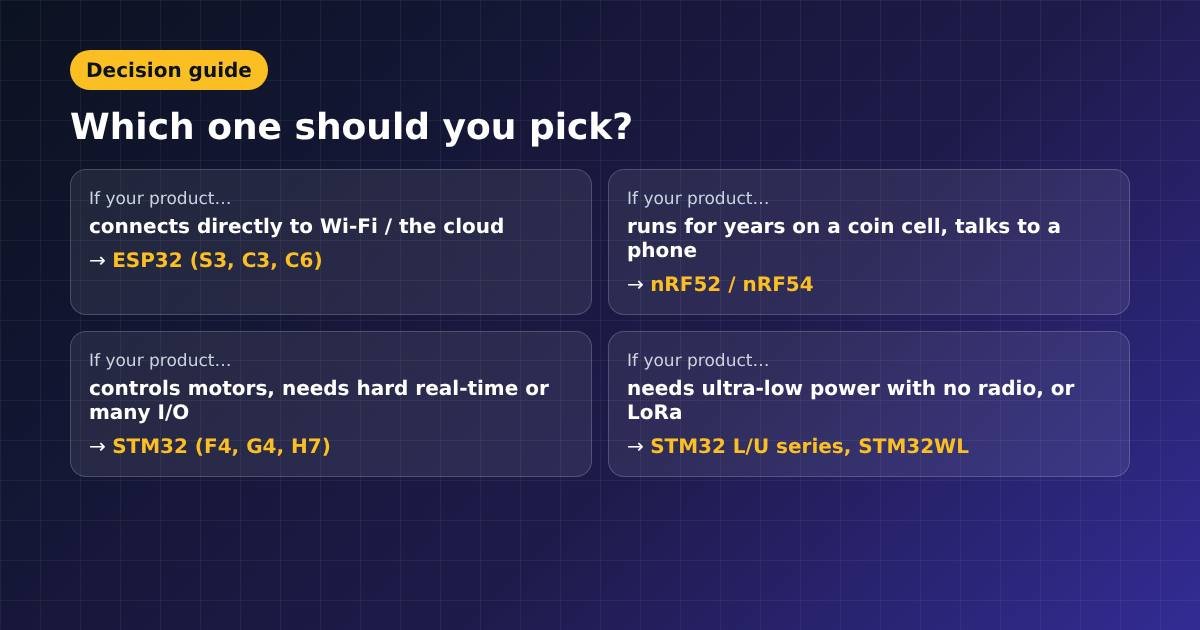
- How does it connect? Wi-Fi → ESP32. BLE to phone → nRF52/54. LoRa, cellular or wired → STM32 (plus a module).
- How is it powered? Mains or rechargeable → any. Coin cell or multi-year battery → nRF or STM32 L/U.
- What does it control? Motors, precise timing or lots of I/O → STM32.
- How much intelligence? Displays, voice or edge AI → ESP32-S3 or STM32H7.
- What's your volume and budget? Compare the full BOM and certification cost at your target volume.
There's no "best" microcontroller, only the best one for your product's requirements.
Can you combine them?
Yes, and many professional products do. A common pattern is an STM32 handling real-time control and sensors, paired with an ESP32 acting as a Wi-Fi co-processor. Another is an nRF52 sensor node that reports to an ESP32-based Wi-Fi gateway. This lets each chip do what it does best.
Frequently asked questions
Is ESP32 good enough for commercial products?
Yes. ESP32 is used in many commercial devices, especially in smart home and consumer IoT. Using pre-certified modules and a proper firmware architecture (secure boot, flash encryption, OTA updates) makes it production-ready.
Which microcontroller has the best battery life?
For wireless devices, the Nordic nRF52/nRF54 series generally offers excellent battery life over Bluetooth LE. For non-wireless or LoRa devices, STM32 L and U series are designed for ultra-low power.
Is STM32 better than ESP32?
Neither is better overall. STM32 wins on peripherals, real-time control and portfolio range. ESP32 wins on built-in Wi-Fi, cost and prototyping speed. The right answer depends on your product.
Which chip is best for Matter smart-home devices?
Options with 802.15.4 radios for Thread, such as the ESP32-C6 or nRF52840, are popular for Matter devices, while Wi-Fi-only Matter devices can use other ESP32 variants.
Can I switch microcontrollers later?
You can, but it usually means a new PCB layout, new firmware drivers and re-certification. That's why choosing carefully at the start saves time and money.
Planning the software side too? Read our guide on AI-powered IoT dashboard development.
Not sure which microcontroller is right for you?
At SD Corpe, we've designed hardware and firmware around ESP32, STM32 and Nordic platforms. We'll help you weigh connectivity, power, cost and certification, then take your product from schematic to production.
Book a free consultation with our embedded team today, and choose your microcontroller with confidence.