"How much will my IoT product cost to build?" It's the first question almost every founder, product manager and OEM asks, and one of the hardest to answer from online guides. Most of them quote software-only app prices and ignore hardware, firmware, enclosures and certification, which together can make up most of the budget.
This guide gives you a realistic breakdown of IoT product development cost in 2026: typical budget ranges, where the money goes, how location and team model affect price, the hidden costs people forget, and practical ways to spend less without cutting quality.
Note: all figures are indicative ranges in USD to help you plan. Your actual cost depends on features, complexity, volumes, timelines and where your team is based. A short discovery session is the best way to get a firm quote.
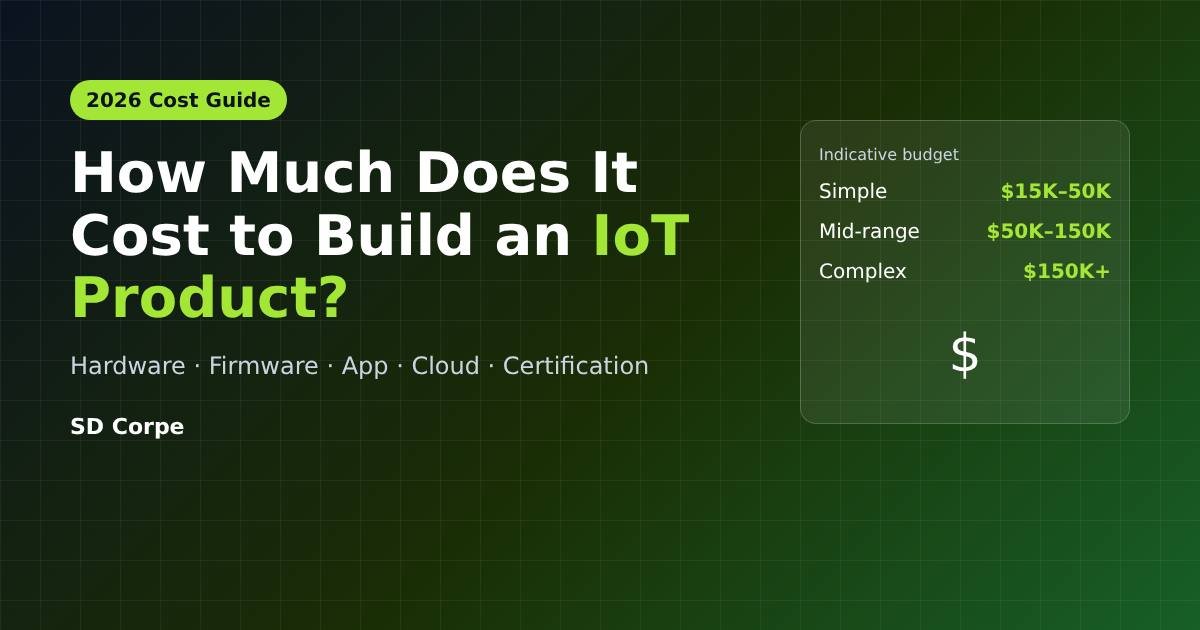
Quick answer: how much does an IoT product cost?
- Simple IoT product: $15,000–$50,000. For example, a Wi-Fi sensor or smart plug using an off-the-shelf module, basic firmware and a simple app or dashboard.
- Mid-range IoT product: $50,000–$150,000. For example, a custom PCB, BLE or Wi-Fi, a mobile app, a cloud dashboard, OTA updates and wireless certification.
- Complex or industrial IoT product: $150,000–$500,000+. For example, multiple boards, cellular or LoRaWAN, rugged enclosures, an enterprise platform, integrations and certification in several markets.
These ranges cover development up to a production-ready product. Per-unit manufacturing cost (BOM, assembly, packaging, logistics) is separate and depends on your volumes.
What makes up the cost of an IoT product?
An IoT product is really four products in one: hardware, firmware, software and compliance. Here's what each stage typically involves.
1. Discovery and product definition ($3,000–$15,000)
Requirements, feature prioritisation, component selection, a feasibility check and a project roadmap. This is the cheapest stage, and the one that prevents the most expensive mistakes.
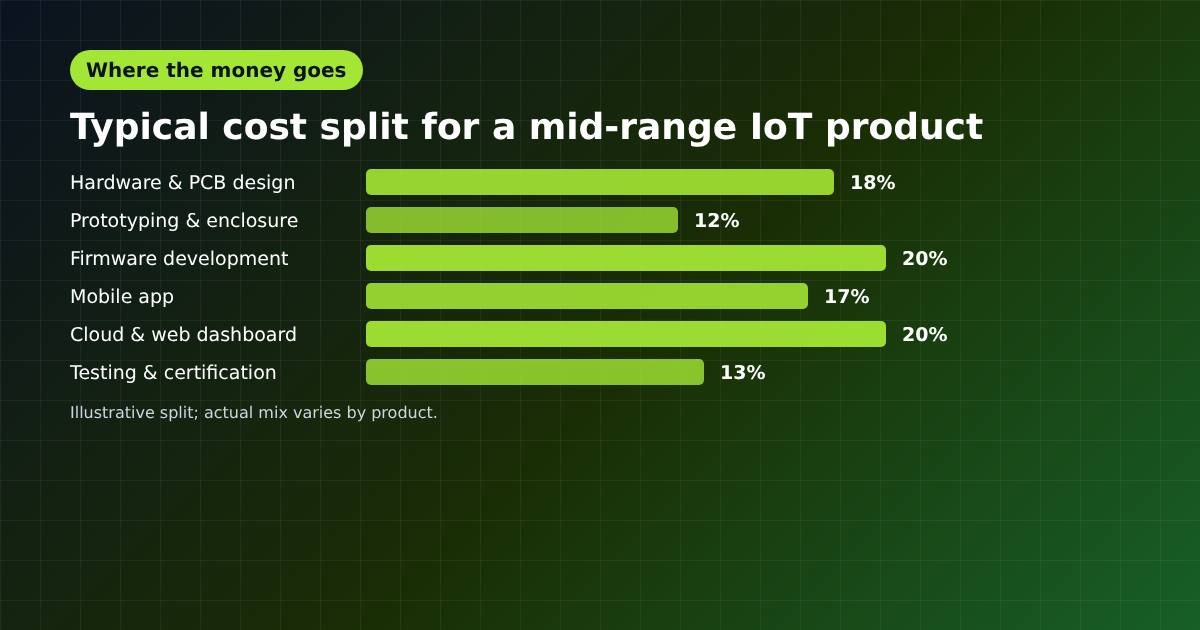
2. Hardware and PCB design ($10,000–$50,000)
Schematic design, component selection, PCB layout, power design and design-for-manufacturing (DFM) checks. Cost rises with board layers, RF design, high-speed interfaces and the number of boards.
3. Prototyping and enclosure ($5,000–$30,000)
PCB fabrication and assembly for prototype batches, 3D-printed or CNC enclosures and usually two or three design iterations. If you need injection-moulded enclosures for production, mould tooling is an extra one-time cost, commonly from about $10,000 to well over $50,000 depending on part size and complexity.
4. Firmware development ($15,000–$80,000)
Drivers, sensor logic, connectivity (Wi-Fi, BLE, LoRaWAN, LTE-M/NB-IoT), power management, security (secure boot, encryption) and over-the-air (OTA) updates. Firmware is often underestimated, but it's what makes the hardware reliable in the field.
5. Mobile app ($20,000–$100,000)
Device pairing and provisioning, live data, controls, notifications and user accounts on iOS and Android. Cross-platform frameworks like Flutter or React Native can reduce this cost.
6. Cloud platform and web dashboard ($20,000–$120,000)
Device management, data storage, APIs, alerts, analytics, admin panels and multi-tenant access. AI-assisted engineering can shorten this stage significantly. Read how AI speeds up IoT dashboard development.
7. Testing and certification ($10,000–$60,000+)
Functional, environmental and field testing, plus regulatory approvals for every market you sell in. Common ones include FCC (USA), ISED (Canada), CE / RED (European Union), UKCA (United Kingdom) and RCM (Australia/New Zealand), plus safety standards and, for cellular products, carrier certification. Some markets also have growing cybersecurity requirements for connected devices. Using pre-certified wireless modules can reduce cost and risk considerably.
Example budgets
Smart home plug (simple)
ESP32 module, relay and power-metering circuit, Wi-Fi connectivity, a basic app with on/off control, scheduling and energy reports. Indicative budget: $25,000–$50,000.
BLE health wearable (mid-range)
Compact custom PCB, nRF52-class microcontroller, sensors, rechargeable battery, a companion iOS/Android app with cloud sync, and FCC/CE certification. Indicative budget: $80,000–$200,000. Medical claims or regulatory approval would add more.
Industrial monitoring system (complex)
Rugged sensor nodes, LoRaWAN or LTE gateways, an STM32-based controller, a multi-site web dashboard with alerts and reports, and integration with ERP or SCADA systems. Indicative budget: $150,000–$400,000+.
Not sure which chip your product needs? See our guide: ESP32 vs STM32 vs nRF52.
How location and team model affect cost
Where your engineering team is based has a big effect on your budget. Typical hourly rates vary widely by region:
- USA, Canada and Western Europe: roughly $100–$200+ per hour
- Eastern Europe and Latin America: roughly $40–$90 per hour
- India and South-East Asia: roughly $25–$60 per hour
Many companies now combine local product ownership with an experienced offshore engineering partner. Done well, this can lower development cost substantially while keeping quality high. The key is choosing a partner with real hardware and software experience, clear communication and transparent processes.
Hidden costs people forget
- Design re-spins: each PCB revision means new fabrication, assembly and testing.
- Mould tooling: a large one-time cost for injection-moulded enclosures.
- Certification retests: failing EMC or RF tests means redesign and paying the lab again, sometimes for several markets.
- Cloud running costs: servers, databases, SMS and push notifications grow with your device count.
- Connectivity fees: cellular data plans for LTE-M or NB-IoT devices.
- Maintenance and updates: budget roughly 15–20% of development cost per year for bug fixes, OS updates, security patches and new features.
- Component price swings and lead times: plan alternates for critical parts.
Factors that increase or decrease cost
- Connectivity: cellular and LoRaWAN add more cost and certification effort than BLE or Wi-Fi.
- Target markets: each region adds certification and labelling work.
- Battery life targets: ultra-low-power designs need more engineering and testing.
- Size constraints: compact wearables need denser PCBs and more iterations.
- Security and compliance: medical, industrial and payment use cases need stronger security and documentation.
- Number of platforms: iOS, Android, web and admin portals each add scope.
- Integrations: ERP, SCADA, CRM or third-party APIs add development and testing time.
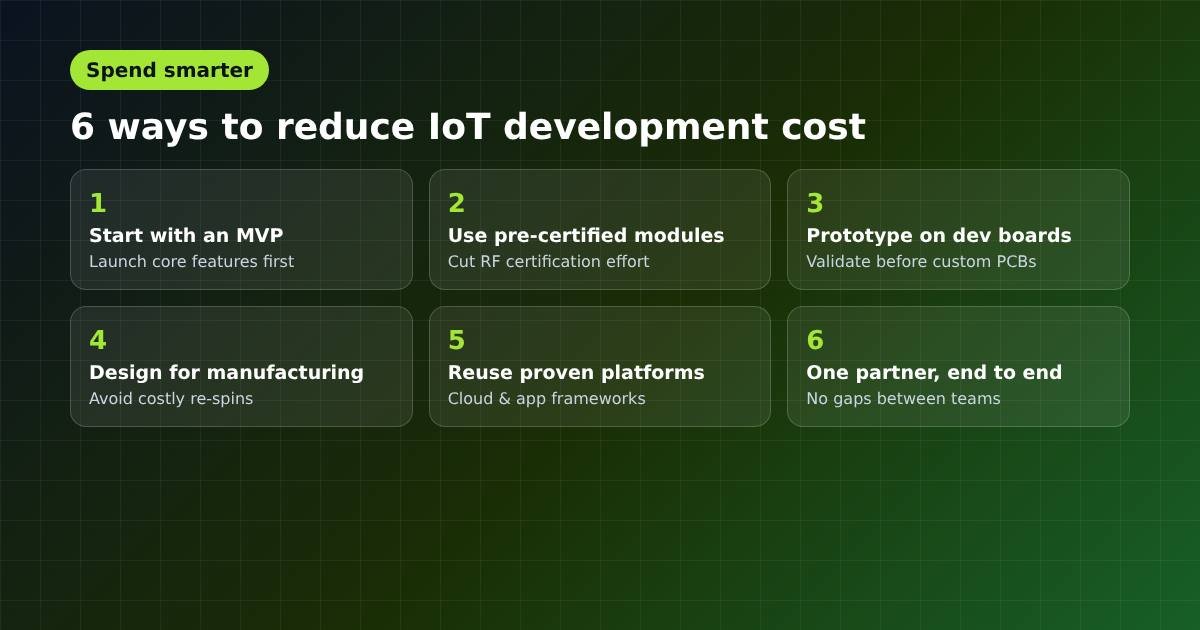
6 ways to reduce your IoT development cost
- Start with an MVP. Launch with core features, learn from users, then invest in what they actually use.
- Use pre-certified modules. They simplify RF design and reduce certification effort in every market.
- Prototype on development boards first. Validate your idea before paying for custom PCBs.
- Design for manufacturing from day one. This avoids expensive re-spins and assembly problems later.
- Reuse proven platforms. Cross-platform apps and ready cloud building blocks save months.
- Work with one end-to-end partner. When hardware, firmware and software teams are separate, the gaps between them cost time and money.
How long does it take?
A simple IoT product can move from idea to a production-ready version in roughly 3–4 months. Mid-range products typically take 5–9 months, and complex industrial systems 9–15 months or more, including certification. Running hardware, firmware and software in parallel shortens timelines considerably.
Frequently asked questions
What is the minimum budget to build an IoT product?
A basic proof of concept using off-the-shelf modules can start from around $5,000–$15,000. A market-ready product with custom hardware, an app and certification typically starts from around $15,000–$50,000.
Why is IoT development more expensive than app development?
Because you're building physical hardware, embedded firmware, cloud software and mobile apps that must all work together reliably, plus meeting regulatory requirements for wireless devices.
What certifications does an IoT device need?
It depends on where you sell. Common examples are FCC for the USA, ISED for Canada, CE/RED for the EU, UKCA for the UK and RCM for Australia, plus electrical safety standards. Always confirm the current rules for your product category and target markets.
Can outsourcing reduce IoT development cost?
Yes. Working with an experienced offshore engineering partner can significantly reduce cost compared with in-house teams in high-cost regions, as long as the partner has proven hardware, firmware and software expertise.
What are the ongoing costs after launch?
Plan for cloud hosting, cellular connectivity (if used), app store accounts, customer support, and around 15–20% of development cost per year for maintenance and updates.
Get an accurate estimate for your IoT product
At SD Corpe, we build complete IoT products for clients worldwide: hardware and PCB design, embedded firmware, mobile apps and cloud dashboards, all under one roof. That means fewer handoffs, fewer surprises, competitive pricing and a clear budget from day one.
Share your idea with us for a free consultation. We'll help you define the right scope and give you a transparent cost and timeline estimate.